level-one heading

Why Kolabtree
Getting started is quick and easy. No upfront fees
It’s free to request a service and invite bids from experts
Discuss requirements with the expert in detail before accepting statement of work from Kolabtree
Collaborate with the expert directly to get your work done the right way
Fund project when you hire the expert, but approve the deliverables only once work is done
Want to hire this expert for a project? Request a quote for free.
Profile Details
Create Project
★★★★★
☆☆☆☆☆
USD 60 /hr
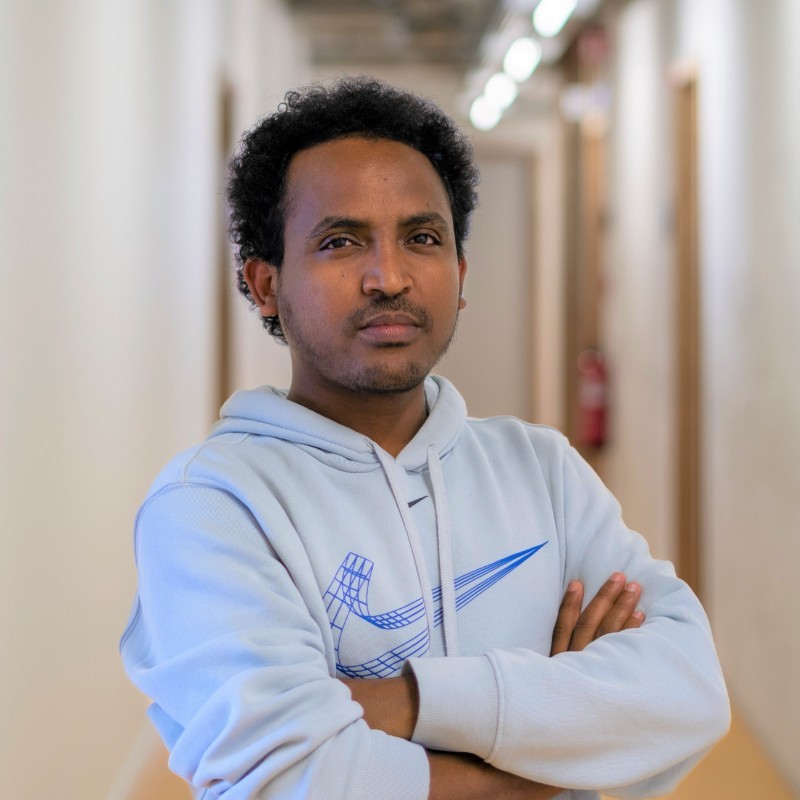
Hire Dr. Merkebu G.
United States
USD 60 /hr

PhD in Computer Engineering with extensive research experience in AI/ML, wireless systems, and signal processing.

Profile Summary
Subject Matter Expertise
Services
Writing Technical Writing, Creative Writing
Research User Research, Technology Scouting, Fact Checking
Data & AI Predictive Modeling, Statistical Analysis, Image Processing, Algorithm Design-ML, Data Visualization
Work Experience

Imec

- Present

PhD student

Ghent University

December 2018 - Present

Reseracher

Ghent University and IMEC

December 2018 - April 2024

Education

Doctor of Philosophy (Ph.D)

Ghent University

December 2018 - November 2023

Certifications
  • NA

    NA

    January 2025 - Present

Publications
JOURNAL ARTICLE
Merkebu Girmay, Vasilis Maglogiannis, Dries Naudts, Timo De Waele, Eli De Poorter, Adnan Shahid, H. Vincent Poor, Ingrid Moerman (2024). Enabling Uncoordinated Dynamic Spectrum Sharing Between LTE and NR Networks . IEEE Transactions on Wireless Communications.
Merkebu Girmay, Vasilis Maglogiannis, Dries Naudts, Muhammad Aslam, Adnan Shahid, Ingrid Moerman (2023). Technology recognition and traffic characterization for wireless technologies in ITS band . Vehicular Communications.
Technology recognition and traffic characterization for wireless technologies in ITS band @article{01GPWZAV481G6WN28HS9ASW6R4, abstract = {{The rapid advancement of wireless technologies requires efficient spectrum management considering issues such as interference management and fair coexistence between different technologies. Wireless technology recognition is one of the approaches used to enable intelligent spectrum management. This work proposes a technology classification and traffic characterization system that can recognize and characterize a wide range of wireless technologies that may coexist in the ITS 5.9 GHz band, namely LTE, Wi-Fi, 5G NR, C-V2X PC5, and ITS-G5 technologies. Compared to current state-of-the-art technology recognition solutions, a short time resolution window is selected based on the shortest possible frame duration of the considered technologies. We carried out a "complexity and accuracy trade-off" analysis for six distinct technology recognition models trained and validated at different sampling rates, including 1, 5, 10, 15, 20, and 25 Msps. In addition, the performance of the technology recognition models was evaluated under different channel conditions. For average to high SNR, a less complex CNN model with lower sampling rates (e.g., 5 Msps) can effectively distinguish the signal with 96% classification accuracy. On the other hand, high classification accuracy is obtained using complex, high sampling rate-based CNN models (e.g., 20 Msps) for low (less than 0 dB) SNR channels. A traffic characterization process is also proposed, where the output of the technology recognition is used to identify the traffic characteristics of the technologies in terms of channel occupancy time, transmission pattern, and frame count. The obtained results show that the proposed solution can be used to effectively characterize the identified traffic. (c) 2022 Elsevier Inc. All rights reserved.}}, articleno = {{100563}}, author = {{Girmay, Merkebu and Maglogiannis, Vasilis and Naudts, Dries and Aslam, Muhammad and Shahid, Adnan and Moerman, Ingrid}}, issn = {{2214-2096}}, journal = {{VEHICULAR COMMUNICATIONS}}, keywords = {{ITS band,Technology recognition,CNN,Spectrum sharing,Multi-RAT, Vehicular communications,WI-FI,FAIR COEXISTENCE,LTE,SPECTRUM}}, language = {{eng}}, pages = {{15}}, publisher = {{ELSEVIER}}, title = {{Technology recognition and traffic characterization for wireless technologies in ITS band}}, url = {{http://dx.doi.org/10.1016/j.vehcom.2022.100563}}, volume = {{39}}, year = {{2023}}, } . VEHICULAR COMMUNICATIONS.
Merkebu Girmay, Vasilis Maglogiannis, Dries Naudts, Adnan Shahid, Ingrid Moerman (2021). Coexistence Scheme for Uncoordinated LTE and WiFi Networks Using Experience Replay Based Q-Learning . Sensors.
Merkebu Girmay, Adnan Shahid, Vasilis Maglogiannis, Dries Naudts, Ingrid Moerman(2021). Machine Learning Enabled Wi-Fi Saturation Sensing for Fair Coexistence in Unlicensed Spectrum . IEEE Access. 9. p. 42959--42974. Institute of Electrical and Electronics Engineers ({IEEE})
Coexistence scheme for uncoordinated LTE and WiFi networks using experience replay based Q-learning @article{8728870, abstract = {{Nowadays, broadband applications that use the licensed spectrum of the cellular network are growing fast. For this reason, Long-Term Evolution-Unlicensed (LTE-U) technology is expected to offload its traffic to the unlicensed spectrum. However, LTE-U transmissions have to coexist with the existing WiFi networks. Most existing coexistence schemes consider coordinated LTE-U and WiFi networks where there is a central coordinator that communicates traffic demand of the co-located networks. However, such a method of WiFi traffic estimation raises the complexity, traffic overhead, and reaction time of the coexistence schemes. In this article, we propose Experience Replay (ER) and Reward selective Experience Replay (RER) based Q-learning techniques as a solution for the coexistence of uncoordinated LTE-U and WiFi networks. In the proposed schemes, the LTE-U deploys a WiFi saturation sensing model to estimate the traffic demand of co-located WiFi networks. We also made a performance comparison between the proposed schemes and other rule-based and Q-learning based coexistence schemes implemented in non-coordinated LTE-U and WiFi networks. The simulation results show that the RER Q-learning scheme converges faster than the ER Q-learning scheme. The RER Q-learning scheme also gives 19.1% and 5.2% enhancement in aggregated throughput and 16.4% and 10.9% enhancement in fairness performance as compared to the rule-based and Q-learning coexistence schemes, respectively.}}, articleno = {{6977}}, author = {{Girmay, Merkebu and Maglogiannis, Vasilis and Naudts, Dries and Shahid, Adnan and Moerman, Ingrid}}, issn = {{1424-8220}}, journal = {{SENSORS}}, keywords = {{FAIR COEXISTENCE,FI,LAA,LTE-U,IEEE802.11,experience replay,Q-learning,coexistence}}, language = {{eng}}, number = {{21}}, pages = {{24}}, title = {{Coexistence scheme for uncoordinated LTE and WiFi networks using experience replay based Q-learning}}, url = {{http://dx.doi.org/10.3390/s21216977}}, volume = {{21}}, year = {{2021}}, } . SENSORS.
Merkebu Girmay, Shahid, Adnan, Maglogiannis, Vasilis, Naudts, Dries, Ingrid Moerman(2021). Machine Learning Enabled Wi-Fi Saturation Sensing for Fair Coexistence in Unlicensed Spectrum . IEEE ACCESS. 9. p. 42959--42974. Ieee-inst Electrical Electronics Engineers Inc
PREPRINT
Merkebu Girmay, Mohamed Seif, Vasilis Maglogiannis, Dries Naudts, Adnan Shahid, H. Vincent Poor, Ingrid Moerman (2023). Over-the-air Aggregation-based Federated Learning for Technology Recognition in Multi-RAT Networks .
Merkebu Girmay, Mohamed Seif, Vasilis Maglogiannis, Dries Naudts, adnan shahid, H. Vincent Poor, ingrid moerman (2023). Over-the-air Aggregation-based Federated Learning for Technology Recognition in Multi-RAT Networks .
Merkebu Girmay, Vasilis Maglogiannis, Dries Naudts, Timo De Waele, Eli De Poorter, adnan shahid, H. Vincent Poor, ingrid moerman (2023). Enabling Uncoordinated Dynamic Spectrum Sharing Between LTE and NR Networks .
Merkebu Girmay, Vasilis Maglogiannis, Dries Naudts, Timo De Waele, Eli De Poorter, Adnan Shahid, H. Vincent Poor, Ingrid Moerman (2023). Enabling Uncoordinated Dynamic Spectrum Sharing Between LTE and NR Networks .
Merkebu Girmay, Vasilis Maglogiannis, Dries Naudts, Timo De Waele, adnan shahid, ingrid moerman, Eli De Poorter, H. Vincent Poor (2023). Enabling Uncoordinated Dynamic Spectrum Sharing Between LTE and NR Networks .
Merkebu Girmay, Vasilis Maglogiannis, Dries Naudts, Timo De Waele, Adnan Shahid, Eli De Poorter, H. Vincent Poor, Ingrid Moerman(2023). Enabling Uncoordinated Dynamic Spectrum Sharing Between LTE and NR Networks . Institute of Electrical and Electronics Engineers ({IEEE})
CONFERENCE PAPER
An adaptive MBSFN resource allocation algorithm for multicast and unicast traffic @inproceedings{01H11F0V2YJFGG0A9J95CQVW5W, abstract = {{The need for supporting multimedia streaming services in cellular networks as standardized by 3GPP is expanding rapidly. Evolved Multimedia Broadcast Multicast Service (eMBMS) was initially introduced in Release 9 and following releases have introduced several enhancements. Multimedia Broadcast Multicast Single Frequency Network (MBSFN) is one of the eMBMS enhancements targeting to reduce interference, however, its static parameter configuration yields inefficient resource allocation. Therefore, in this paper, an adaptive demand-driven MBSFN resource allocation algorithm is proposed aiming to efficiently utilize the radio resources. The algorithm flexibly assigns resources to multicast transmissions by varying MBSFN configuration parameters (the number and period of multicast subframes) and provides freed resources to unicast traffic. The proposed algorithm is implemented and evaluated using a Software Defined Radio platform which we made open source. As compared to the fixed MBSFN parameter configuration, our solution showcases an improvement of at least 24% and maximally by 40% in terms of multicast resource efficiency. Also, the total system throughput (multicast and unicast) improves by at least 4% and maximally by 24%.}}, author = {{Khalid, Ihtisham and Girmay, Merkebu and Maglogiannis, Vasilis and Naudts, Dries and Shahid, Adnan and Moerman, Ingrid}}, booktitle = {{2023 IEEE 20TH CONSUMER COMMUNICATIONS & NETWORKING CONFERENCE, CCNC}}, isbn = {{9781665497343}}, issn = {{2331-9852}}, keywords = {{LTE,eMBMS,MBSFN,multicast traffic,dynamic resource allocation,unicast traffic,SDR}}, language = {{eng}}, location = {{Las Vegas, NV}}, pages = {{579--586}}, publisher = {{IEEE}}, title = {{An adaptive MBSFN resource allocation algorithm for multicast and unicast traffic}}, url = {{http://doi.org/10.1109/ccnc51644.2023.10060040}}, year = {{2023}}, } .
Intelligent spectrum sharing between LTE and Wi-Fi networks using muted MBSFN subframes @inproceedings{01H11DJKA5QDZPDY95Q19MN4S9, abstract = {{Due to the fast growth of diverse wireless network deployments, the radio spectrum is becoming scarce. Hence, it is beneficial that different radio access technologies share the spectrum in a harmonious way. In this paper, we propose a co-existence scheme between Long Term Evolution (LTE) and Wi-Fi networks that utilizes a Multimedia Broadcast Multicast Service (MBMS) over a Single Frequency Network (MBSFN) feature of an LTE network. MBSFN is an LTE feature that provides support for multicast/broadcast traffic. We propose an adaptive scheme that configures muted subframes, initially intended for MBSFN operation, to allow Wi-Fi transmissions. For the adaptive configuration of muted MBSFN subframes, the LTE eNB uses its traffic queue and the Wi-Fi spectrum occupancy information, which is determined by a convolutional neural network-based technology recognition and traffic characterization system. The standard LTE System Information Blocks are used to convey the updated configuration to the LTE UE. Hence, the proposed coexistence scheme doesn’t require any modifications to a standard MBSFN-compliant LTE UE. Performance analysis is done for various traffic situations, and the results show that muted MBSFN subframe-based coexistence gives a 15% improvement in average aggregated throughput as compared to using Almost Blank Subframe-based coexistence.}}, author = {{Girmay, Merkebu and Avila-Campos, Pablo and Maglogiannis, Vasilis and Naudts, Dries and Shahid, Adnan and Moerman, Ingrid}}, booktitle = {{2023 IEEE Wireless and Microwave Technology Conference (WAMICON)}}, isbn = {{9798350398649}}, keywords = {{Software Defined Radio (SDR),Spectrum Sharing,Technology Recognition,Wi-Fi,LTE,MBSFN}}, language = {{eng}}, location = {{Melbourne, FL, USA}}, pages = {{13--16}}, publisher = {{IEEE}}, title = {{Intelligent spectrum sharing between LTE and Wi-Fi networks using muted MBSFN subframes}}, url = {{http://doi.org/10.1109/wamicon57636.2023.10124903}}, year = {{2023}}, } .
Residual service time optimization for legacy wireless-TSN end nodes @inproceedings{01H6R6E6CAPEWN9CC510PFG84D, abstract = {{The emergence of Time-Sensitive Networking (TSN) has enabled network determinism to a new level, offering high reliability and bounded latency for critical communications. However, the unpredictable nature of traffic generation also poses new challenges to TSN. While TSN is designed to maintain backward compatibility with the 802.1 standards, many end nodes may not be equipped to understand TSN. This can result in a less deterministic TSN, and suboptimal resource utilization, mainly driven by Residual Service Time (RST). To address these challenges, this study proposes three scheduling mechanisms to reduce RST: q-learning, active time slot update, and polynomial forecasting. Real-world data captured from our wireless-TSN (W-TSN) evaluation kit is used to compare the proposed approaches in terms of one-way latency. The results show that the machine learning approach outperforms the other methods in terms of overall latency. However, it is less effective in identifying the optimal time slot position compared to the other methods.}}, author = {{Avila-Campos, Pablo and Haxhibeqiri, Jetmir and Girmay, Merkebu and Moerman, Ingrid and Hoebeke, Jeroen}}, booktitle = {{2023 19th International Conference on Wireless and Mobile Computing, Networking and Communications (WiMob)}}, isbn = {{9798350336689}}, issn = {{2160-4886}}, keywords = {{residual service time,reinforcement learning,machine learning,scheduling,wireless time-sensitive networking}}, language = {{eng}}, location = {{Montréal, Canada}}, pages = {{466--471}}, publisher = {{IEEE}}, title = {{Residual service time optimization for legacy wireless-TSN end nodes}}, url = {{http://doi.org/10.1109/wimob58348.2023.10187722}}, year = {{2023}}, } .
Merkebu Girmay, Mickael Maman, Esteban Catte, Mohamed Sana, Vasilis Maglogiannis, Dries Naudts, Haeyoung Lee, Francois Carrez, Antti Anttonen, Yolanda Fernandez, et al.(2022). Coverage Extension as a Service for Flexible 6G Networks Infrastructure . 2022 IEEE Globecom Workshops (GC Wkshps). {IEEE}
Merkebu Girmay, Mickael Maman, Esteban Catte, Mohamed Sana, Vasilis Maglogiannis, Dries Naudts, Haeyoung Lee, Francois Carrez, Antti Anttonen, Yolanda Fernandez, et al. (2022). Coverage Extension as a Service for Flexible 6G Networks Infrastructure . IEEE GLOBECOM - Workshop on Low Power Wide Area Networking Technologies for Emerging Internet of Things (LPWA4IoT).
Merkebu Girmay, Soto, Paola, Camelo, Miguel, Jaron Fontaine, Shahid, Adnan, Maglogiannis, Vasilis, Eli De Poorter, Moerman, Ingrid, Botero, Juan F., Latré, Steven, et al.(2020). Augmented Wi-Fi : an AI-based Wi-Fi management framework for Wi-Fi/LTE coexistence . 1--9IEEE
Merkebu Girmay, Maglogiannis, Vasilis, Naudts, Dries, Jaron Fontaine, Shahid, Adnan, Eli De Poorter, Moerman, Ingrid(2020). Adaptive CNN-based private LTE solution for fair coexistence with Wi-Fi in unlicensed spectrum . 346--351IEEE
DISSERTATION THESIS
Intelligent spectrum sharing mechanisms for heterogeneous wireless access networks @phdthesis{01HEMH24ENR0S4QKKKN3SGRD80, abstract = {{De laatste tijd neemt het gebruik van draadloze communicatieapparaten die zijn verbonden met verschillende netwerken, zoals Wi-Fi, 4G en 5G, snel toe. Naarmate deze groei voortduurt, wordt het van cruciaal belang om het beperkte spectrum waarbinnen deze apparaten moeten werken efficiënt te beheren. Stel je de communicatie tussen deze apparaten voor als een volgepakte kamer met mensen die tegen elkaar praten; soms kunnen hun gesprekken elkaar overlappen, waardoor verwarring ontstaat. Een soortgelijk scenario, interferentie genoemd, doet zich voor wanneer verschillende, op dezelfde locatie geplaatste draadloze netwerkapparaten hun signaal tegelijkertijd in hetzelfde spectrum verzenden. Als oplossing voor dit probleem richt dit proefschrift zich op het ontwikkelen van effectieve mechanismen voor het delen van spectrum tussen verschillende draadloze technologieën in dezelfde spectrumband. De studie onderzoekt mechanismen om verschillende soorten draadloze signalen en dataverkeerspatronen te herkennen en stelt vervolgens methoden voor om spectrum efficiënter te delen. Het doel is ervoor te zorgen dat verschillende draadloze technologieën naast elkaar kunnen bestaan, zodat gebruikers een betere servicekwaliteit over een breder spectrum kunnen ervaren. Het onderzoek omvat verschillende methoden die machine learning-technieken gebruiken om signalen van verschillende apparaten die gebruik maken van allerhande draadloze netwerken te identificeren en op basis daarvan beslissingen over spectrumresourcebeheer te nemen.}}, author = {{Girmay, Merkebu}}, isbn = {{9789463557696}}, language = {{eng}}, pages = {{XXX, 250}}, publisher = {{Ghent University. Faculty of Engineering and Architecture}}, school = {{Ghent University}}, title = {{Intelligent spectrum sharing mechanisms for heterogeneous wireless access networks}}, year = {{2023}}, } .